
 By Stefan Oliva
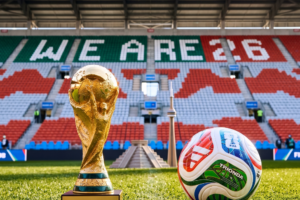
The biggest sporting event in the world is expected to be the biggest it’s ever been. The 2026 Men’s World Cup is a tournament of many firsts. It will be hosted by three countries (the U.S, Mexico, and Canada), with an unprecedented 48 teams playing 104 games in 16 cities. Because of that, the group stage will be longer than it’s ever been, and people can watch soccer from breakfast to dinner during that period. This year’s World Cup will be played between June 11th and July 19th. Fans from all over the world have already bought more than three million tickets, and attendance is forecasted at over 7 million, according to FIFA, potentially generating more than $17 billion in GDP for the U.S.
Soccer becoming this popular domestically has been more than half a century in the making. Answering why it took so long is more complicated. The game needed 56 years to transform from a niche, unstable novelty into a mainstream sport. Then, there was a transition period. At first, soccer leagues in the U.S. leaned heavily on international players somewhat past their primes. Then, soccer fans from around the world started moving to this country. Later, the national Hispanic population increased, both in immigration and national births, which would allow for youth development, stadium infrastructure, and sustainable corporate partnerships.
The first steps
There were decades of detours and trial and error in professional U.S. soccer leagues. They also had to navigate evolving culture and technology. Before 1975, the sport did not have the national sway it does now. Initially, there was a lack of interest, bordering on disdain for the game, which did not provide enough stoppage time or opportunities for advertisers to promote their products.
Additionally, there wasn’t a soccer specific infrastructure. Professional teams were borrowing fields from football and baseball squads, colleges, universities, and virtually anywhere. It was the same for kids’ soccer, but that has since changed. “At the youth level, soccer participation has skyrocketed through the years, making it one of the most, if not the most popular sport among boys and girls,” said long-time Telemundo World Cup commentator Andres Cantor. “The kids then make their parents fans of the game and of its stars. In lieu of a local hero, there will always be a kid wearing a Real Madrid jersey, a [Lionel] Messi or [Kylian] Mbappe one.”
Crucial changes in the sport’s infrastructure have been made since the 1970s. 22 of the 30 stadiums used by the Major Soccer League (MLS) were built exclusively for soccer. The MLS went from having 10 teams in 1996, its first year, to now having 30. But before the MLS existed, there was the North American Soccer League (NASL), the first domestic one to attract elite players from abroad.
International superstar Pelé’s arrival in 1975 was a spark for American soccer. The then 34-year-old signed a three-year deal – valued somewhere between $2.8 million and $7 million- with the NASL’s New York Cosmos. Before Pelé, the Cosmos’ average attendance was just over 3,500, and that number ballooned to more than 10,000 in the Brazilian’s first season in New York. His team won the NASL championship in 1977. After Pelé left later that year, he was successfully followed by European stars German Franz Beckenbauer and Dutch Johan Cruyff, who were 32 then. They continued to increase attendance, media coverage, and merchandise sales, eventually leading the Cosmos to three championships before leaving the team.
During their tenure, TV viewership also spiked. Pelé’s debut with the Cosmos drew 10 million viewers on CBS. International star talent filled arenas and kept fans near their TVs but did little to keep the NASL and other domestic soccer leagues afloat. Teams were compelled to overpay those stars to keep them in the U.S. “Owners thought they could build a franchise with one star without a team,” said Cantor. “It was a different era all together and the project as they envisioned failed quickly.” Eventually, the NASL didn’t have enough money to stay alive, so it dissolved in 1985.
A second revival
In 1988, FIFA named the U.S. as the 1994 World Cup host. It was the first time in 64 years the U.S. men’s soccer team made it past the first round, falling to eventual champion Brazil 1-0 in the Round of 16. To date, the 1994 World Cup is the biggest in soccer history. More than 3.5 million people attended the 52 games played. “The 1994 World Cup was a gamechanger… as it put soccer on the map,” said Cantor.
American soccer propelled to even greater heights because of an influx of Latinos and soccer-loving European immigrants, along with the creation of the MLS. According to Pew Research, the Latino population in the U.S. grew from over 22 million to 68 million between 1990 and 2024, bringing their culture, passion, and emotion to their favorite sport. Melting pot cities like New York, Philadelphia, and Los Angeles had their own recreational leagues for decades, but eventually soccer got more popular across the rest of the country.
In turn, demand for the game increased substantially. In the webinar “From Streams to Stadiums: How Hispanic Audiences Are Defining What’s Next,” Telemundo Senior Vice President of Research, Strategy and Insights, Federico Garza, said media are still trying to satisfy the appetite of Latinos consuming sports. The Nielsen Fan Insights report states 40% of all Hispanics in the U.S. identify as World Cup fans, a massive market to tap into. Especially since Latinos have more than $4 trillion in purchasing power domestically. “Undoubtedly, the Latino community has been key to the growth of the game in the U.S.,” said Cantor. “They have supported [the] MLS from day one and also the National Team’s program.”
A prime example of that is soccer merchandise expanding is the increased sales of teams’ kits and apparel, which shifted from heavy white cotton to a much lighter polyester. Most modern soccer merchandise has evolved from jerseys to lifestyle apparel, with club gear becoming everyday fashion.
The glamor recipe
As U.S. soccer continued growing, the MLS was able to attract English superstar David Beckham to the Los Angeles Galaxy in 2007 at age 31. His first contract was reportedly 5-years and $250 million, with a big chunk of that coming from a revenue sharing clause with his team. He called it quits in November 2012, less than a year after signing his second deal. His last MLS season was his best. In 2011, he won his first and only MLS Cup and was named an All-Star. He accomplished all this as the internet boomed and social media gained traction, amid the development of some existing platforms.
Along with his play on the pitch, he brought glitz and glamor to the MLS, which were lacking before his arrival. He had endorsement deals with international fashion brands like Emporio Armani and H&M. He was also featured in underwear ads. Beckham became the MLS pretty boy, a soccer fashion icon of sorts. His face was on many billboards, and LA was the perfect place to showcase him and his brand.
The “Bend it like Beckham” era was in full swing, as the league added seven teams since the Brit’s first season. Beckham’s arrival prompted other international stars to follow suit. Thierry Henry joined the New York Red Bulls in 2010, and Zlatan Ibrahimović played on the LA Galaxy for two seasons, joining in 2018. The MLS was then ready to welcome its biggest superstar, Argentinean Lionel Messi, who took his talents to Inter Miami CF in 2023.
The magician and his incredible goals
His arrival propelled U.S. soccer into another stratosphere, birthing “The Messi Effect,” which fueled ratings, social media followers, TV viewership, and the value of Inter Miami CF. Before Messi, the team was worth $585 million according to Sportico. It is now the MLS’ most valuable team at $1.45 billion, slightly ahead of the LA Galaxy, which is worth $1.4 billion. In addition to boosting the league, signing Messi led to more team success for Intern Miami CF, which won its first MLS Cup in 2025.
On the international stage, Messi has played in every World Cup between 2006 and 2022. The upcoming tournament will be his sixth and likely final one, as he has a chance to cement his legacy as soccer’s golden idol.
When it comes to social media, the MLS says its following increased 26% on TikTok, 21% on YouTube and 10% on Instagram in 2024, compared to 2023. The league now has more than 109 million followers on all social media platforms. The MLS claims its total attendance has increased 12% since 2022, averaging more than 11 million fans per year and more than 22,000 per match.
Even with millions of people watching from the stands, billions more will watch wherever they have internet access or a TV. In another Men’s World Cup first, FIFA and TikTok announced a Preferred Platform Partnership to make the tournament more accessible. Certain TikTok creators will have behind the scenes access to some teams’ training sessions, press conferences, and will be able “to use and co-create FIFA archival footage,” according to a media release.
Additionally, broadcasters will be able to monetize “their FIFA World Cup™ coverage through TikTok’s premium advertising solutions.” Parts of games will also be livestreamed and customized clips will be published. This stemmed from the Women’s 2023 World Cup, which generated tens of billions of views.
There’s no reason to expect anything less on the men’s side. This comes as soccer’s fanbase is relying heavily on young people. The Preferred Platform Partnership is crucial in reaching that demographic, where 37% of Hispanic households have a child under 18, compared to 24% for non-Hispanics, according to the Nielsen Fan Insights report.
“I have no doubt the popularity of the sport will grow exponentially,” said Cantor, “and the legacy [of] the World Cup itself will be everlasting for the continued growth of the game and forever cemented in the American scene, and it will convert the casual fan[s] into lifelong ones.”
—
 About Us
VISIONARIOS-Providence is building a verified community of professionals, leaders, and organizations shaping Rhode Island’s economic and cultural future. Our launch year is intentionally selective- focused on quality, relevance, and long-term value for our readers and partners.
BECOME A VERIFIED READER
We invite professionals, entrepreneurs, civic leaders, and decision makers to apply for inclusion in our controlled/verified digital circulation, with priority consideration for future print distribution.
> Apply here for Verified Readership
PARTNER WITH US
VISIONARIOS-Providence collaborates with brands, institutions, and organizations that value thought leadership, community impact, and authentic storytelling.
Request advertising & partnership Information
Contact: jon.andrade@visionariospvd.com
CONTRIBUTE TO THE CONVERSATION
We welcome inquiries from experienced writers, subject-matter experts, and community voices aligned with our editorial focus on leadership, business, and cultural insight.
Contact: jon.andrade@visionariospvd.com